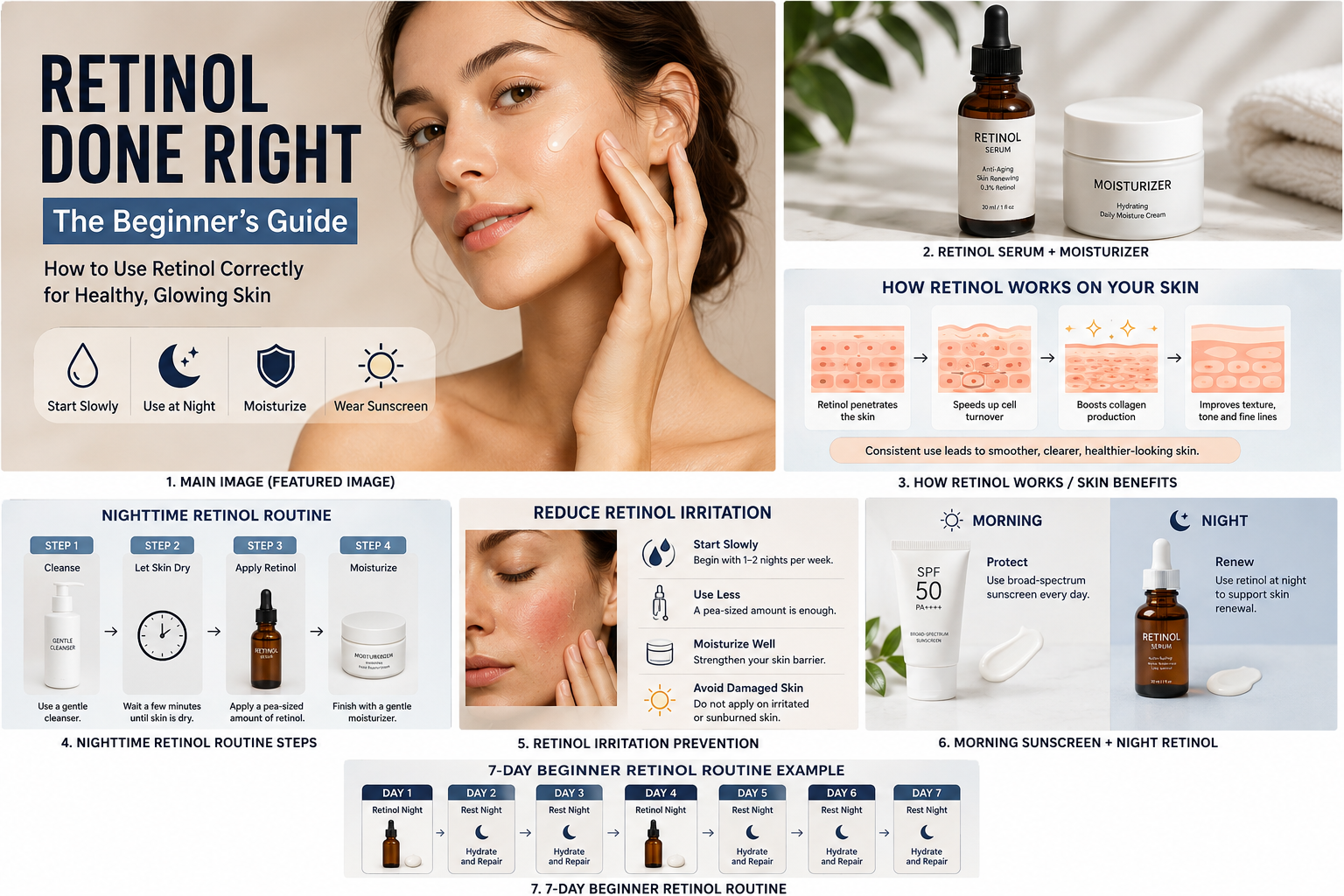
Retinol can be one of the most useful ingredients in an anti-aging skincare routine—but only when you use it correctly.
Using too much retinol, applying it too frequently, or combining it with several irritating ingredients can leave your skin dry, red, flaky and uncomfortable. The good news is that a simple, gradual routine can make retinol much easier to tolerate.
Retinol has become one of the most popular ingredients in modern skincare. It is widely used in products designed to improve the appearance of fine lines, uneven skin tone, rough texture and acne-prone skin.
But there is an important difference between using retinol consistently and simply using a strong product every night.
The goal is not to make your skin peel as much as possible. The goal is to introduce retinol gradually while maintaining a healthy skin barrier.
This guide explains how to use retinol for beginners, how often to apply it, how much to use, how moisturizer fits into the routine, what mistakes to avoid and when you should stop using it.
What Is Retinol?
Retinol is a form of vitamin A that belongs to the broader family of ingredients known as retinoids. Retinoids are widely used in dermatology. Different retinoids have different strengths, formulations and medical indications. Retinol is commonly found in over-the-counter cosmetic skincare products.
When applied to the skin, retinoid ingredients influence processes involved in skin-cell turnover and can help improve the appearance of uneven texture and signs of photoaging.
The American Academy of Dermatology notes that retinoids can be useful for concerns including mild acne, pigmentation irregularities and fine lines and wrinkles.
What Can Retinol Do for Your Skin?
Retinol is popular because it can address several common skincare concerns at the same time.
1. Fine Lines and Wrinkles
Retinoids have been studied extensively for photoaging. They can help improve the appearance of fine lines and support changes associated with collagen and skin-cell turnover.
2. Uneven Skin Texture
Regular retinoid use can help create a smoother-looking skin surface by influencing the turnover of skin cells.
3. Acne-Prone Skin
Retinoids can help prevent clogged pores and are commonly used as part of acne treatment. Prescription retinoids and over-the-counter retinol should not be considered interchangeable, however.
4. Uneven Skin Tone
Retinol may also be useful for people concerned about uneven pigmentation and dull-looking skin.
How to Start Retinol as a Beginner
If you have never used retinol before, the safest strategy is usually to start slowly.
One of the most common mistakes is starting with a high-strength product and applying it every night from day one. That approach can produce unnecessary irritation and may make you abandon the routine before you have had enough time to see the potential benefits.
A better beginner strategy
- Start with a gentle formulation.
- Use a small amount.
- Apply it at night.
- Begin with a low frequency.
- Use moisturizer consistently.
- Increase frequency gradually if your skin tolerates it.
Cleveland Clinic recommends starting slowly because retinol can cause temporary dryness, redness, itching, burning and peeling, particularly when someone is new to the ingredient.
How Much Retinol Should You Use?
One of the most important rules is surprisingly simple:
A small amount is generally enough for the entire face.
Using a large amount does not necessarily accelerate results. Instead, excessive application may increase irritation. Cleveland Clinic specifically recommends approximately a pea-sized amount for the face.
The Correct Nighttime Retinol Routine
A simple nighttime routine is usually easier to maintain than a complicated routine with multiple active ingredients.
Step 1 — Gentle Cleanser
Clean your face gently. Avoid aggressive scrubbing, especially if your skin is already dry or sensitive.
Step 2 — Let Your Skin Dry
If your skin is easily irritated, allowing it to dry completely before applying retinol may make the experience more comfortable.
Step 3 — Apply Retinol
Use a thin layer and avoid the immediate eye area, corners of the nose and lips unless the specific product instructions say otherwise.
Step 4 — Moisturizer
Finish with a gentle moisturizer to help support the skin barrier.
Should You Use Moisturizer Before or After Retinol?
This is one of the most common questions among beginners.
For many people, applying moisturizer after retinol is perfectly reasonable. However, people with sensitive or easily irritated skin may find that applying moisturizer before retinol makes the routine more comfortable.
This approach is sometimes called the "moisturizer sandwich".
Moisturizer Sandwich Method
1. Gentle moisturizer
2. Small amount of retinol
3. Another layer of moisturizer
The best approach depends on the product, your skin type and how sensitive your skin is. Dermatologists may recommend moisturizer before retinoid treatment when irritation is a concern.
How Often Should You Use Retinol?
There is no universal schedule that works for everyone.
A beginner might start with retinol only a couple of nights per week and gradually increase frequency if the skin remains comfortable.
| Stage | Example Frequency | Goal |
|---|---|---|
| Beginner | 1–2 nights/week | Build tolerance |
| Adapting | Every other night | Consistent use |
| Experienced | Based on tolerance | Long-term maintenance |
Do not increase frequency simply because you are not seeing immediate results. Skincare ingredients generally require consistent use over time.
How to Reduce Retinol Irritation
Some dryness or mild irritation can occur when beginning a retinoid. However, severe or persistent irritation is not something you should simply push through.
Use less product
More is not necessarily better. Start with a small amount.
Use it less frequently
If your skin becomes irritated, reduce the frequency rather than forcing yourself to continue every night.
Strengthen your moisturizing routine
A gentle moisturizer can help reduce dryness and support the skin barrier.
Avoid applying retinol to damaged skin
Avoid using retinol on sunburned, broken or already irritated skin.
7 Common Retinol Mistakes
1. Starting Every Night
Your skin may need time to adapt. Starting slowly is usually more sensible than immediately using retinol every night.
2. Applying Too Much
A larger amount does not guarantee faster results.
3. Using Multiple Strong Actives at Once
Combining several potentially irritating ingredients can make it difficult to determine what is causing irritation.
4. Skipping Moisturizer
Retinol can be drying, so moisturizer is an important part of a balanced routine.
5. Forgetting Sunscreen
Daily sun protection is essential when building an anti-aging skincare routine.
6. Expecting Overnight Results
Retinol is a long-term skincare ingredient. Consistency matters more than applying excessive amounts.
7. Continuing Despite Severe Irritation
If you experience significant swelling, severe burning, blistering or a persistent reaction, stop using the product and seek professional medical advice.
Ingredients to Be Careful Combining With Retinol
Retinol does not necessarily need to be isolated from every other skincare ingredient. The problem is that several active ingredients can independently cause irritation.
| Ingredient | Consideration |
|---|---|
| AHA / Glycolic Acid | May increase irritation when combined aggressively. |
| Salicylic Acid | Can be drying or irritating for some people. |
| Benzoyl Peroxide | May increase dryness or irritation depending on the routine. |
| Vitamin C | Can be used strategically, but introducing several actives at once may complicate irritation management. |
Why Sunscreen Is Essential
A retinol routine should not stop at nighttime.
During the day, broad-spectrum sunscreen is one of the most important steps in protecting your skin from UV exposure.
The American Academy of Dermatology recommends broad-spectrum sunscreen with SPF 30 or higher and emphasizes sun-protective behaviors such as shade and protective clothing.
Retinol at night. Sun protection during the day.
Can You Use Retinol During Pregnancy?
This is an important safety question.
Topical retinoids are generally avoided during pregnancy, and people who are pregnant or planning pregnancy should discuss skincare ingredients with their healthcare professional.
A Simple 7-Day Beginner Retinol Routine
| Day | Night Routine |
|---|---|
| Day 1 | Cleanser → Moisturizer → Retinol → Moisturizer |
| Day 2 | Cleanser → Moisturizer |
| Day 3 | Cleanser → Moisturizer |
| Day 4 | Cleanser → Moisturizer → Retinol → Moisturizer |
| Day 5 | Cleanser → Moisturizer |
| Day 6 | Cleanser → Moisturizer |
| Day 7 | Cleanser → Moisturizer |
This is an educational example rather than a personalized medical prescription. Your ideal schedule depends on the product, concentration, skin condition and tolerance.
Retinol vs. Retinal: What's the Difference?
Retinol and retinal, also called retinaldehyde, are both vitamin A derivatives used in skincare. They are related ingredients but are not identical.
Prescription retinoids such as tretinoin are different again and should not be treated as interchangeable with cosmetic retinol products.
If you are new to vitamin A skincare, choosing a product appropriate for your skin type and tolerance is more important than simply choosing the strongest ingredient available.
Who Should Be Especially Careful With Retinol?
- People with very sensitive or easily irritated skin
- People experiencing active skin inflammation
- People with significant dryness or a damaged skin barrier
- People who are pregnant or planning pregnancy
- People using multiple prescription or active skincare products
If you have a dermatologic condition or are using prescription medication, consult a dermatologist before introducing a retinoid.
Frequently Asked Questions
Can I use retinol every night?
Some experienced users may tolerate frequent application, but beginners generally benefit from starting slowly and increasing frequency only if their skin tolerates it.
How long does retinol take to work?
Results vary depending on the product, concentration, skin concern and consistency. Do not judge a retinol routine after only a few applications.
Should I apply retinol before or after moisturizer?
Either approach may be appropriate depending on your skin. Applying moisturizer before retinol can be useful for people who experience irritation, while moisturizer after retinol is a common routine.
Can retinol make my skin peel?
Yes. Dryness, flaking, redness and irritation can occur, especially when starting. Excessive peeling is not a sign that the product is necessarily working better.
Can I use retinol with vitamin C?
They can be incorporated into the same overall skincare routine, but introducing several active ingredients simultaneously can increase the difficulty of managing irritation. A simple approach is often better for beginners.
Should I use sunscreen with retinol?
Yes. Daily broad-spectrum sun protection is an important part of an anti-aging skincare routine.
Can I use retinol during pregnancy?
Topical retinoids are generally avoided during pregnancy. Speak with your healthcare professional if you are pregnant, trying to conceive or unsure whether an ingredient is appropriate.
Is stronger retinol always better?
No. The best product is one you can tolerate and use consistently. Excessive irritation can make a skincare routine difficult to maintain.
The Retinol Beginner's Checklist
✓ Start slowly
✓ Use a small amount
✓ Apply at night
✓ Moisturize regularly
✓ Avoid excessive exfoliation
✓ Wear broad-spectrum sunscreen during the day
✓ Increase frequency only when your skin tolerates it
✓ Stop and seek professional advice if you develop a significant reaction
Final Thoughts
Retinol does not need to be complicated.
The most effective approach for many beginners is not to use the strongest product possible or apply it every night immediately. Instead, focus on gradual introduction, appropriate amounts, moisturization, sun protection and long-term consistency.
The idea is simple: respect your skin barrier while building a routine you can actually maintain.
If irritation becomes significant or you have a specific skin condition, pregnancy-related concerns or questions about prescription retinoids, consult a qualified dermatologist.