If you invest in stocks, you probably spend a lot of time analyzing company earnings, stock charts, news headlines, and financial statements. But there's one number that can influence almost everything in the stock market, yet many beginners overlook it entirely: interest rates.
At first glance, interest rates may seem like something only economists, banks, or central bank policymakers need to worry about. But the truth is far more direct: interest rates have a profound impact on stock valuations, corporate profits, consumer spending, bond yields, and investor sentiment. Understanding this relationship can transform you into a more informed and strategic stock investor.
What Are Interest Rates, Really?
Let's start with the basics. An interest rate is simply the cost of borrowing money. When you borrow from a bank, you pay interest. When you deposit money in a savings account or purchase bonds, you receive interest. The interest rate most relevant to financial markets is the central bank policy rate, because changes to this rate ripple through the entire economy, influencing borrowing costs for everyone.
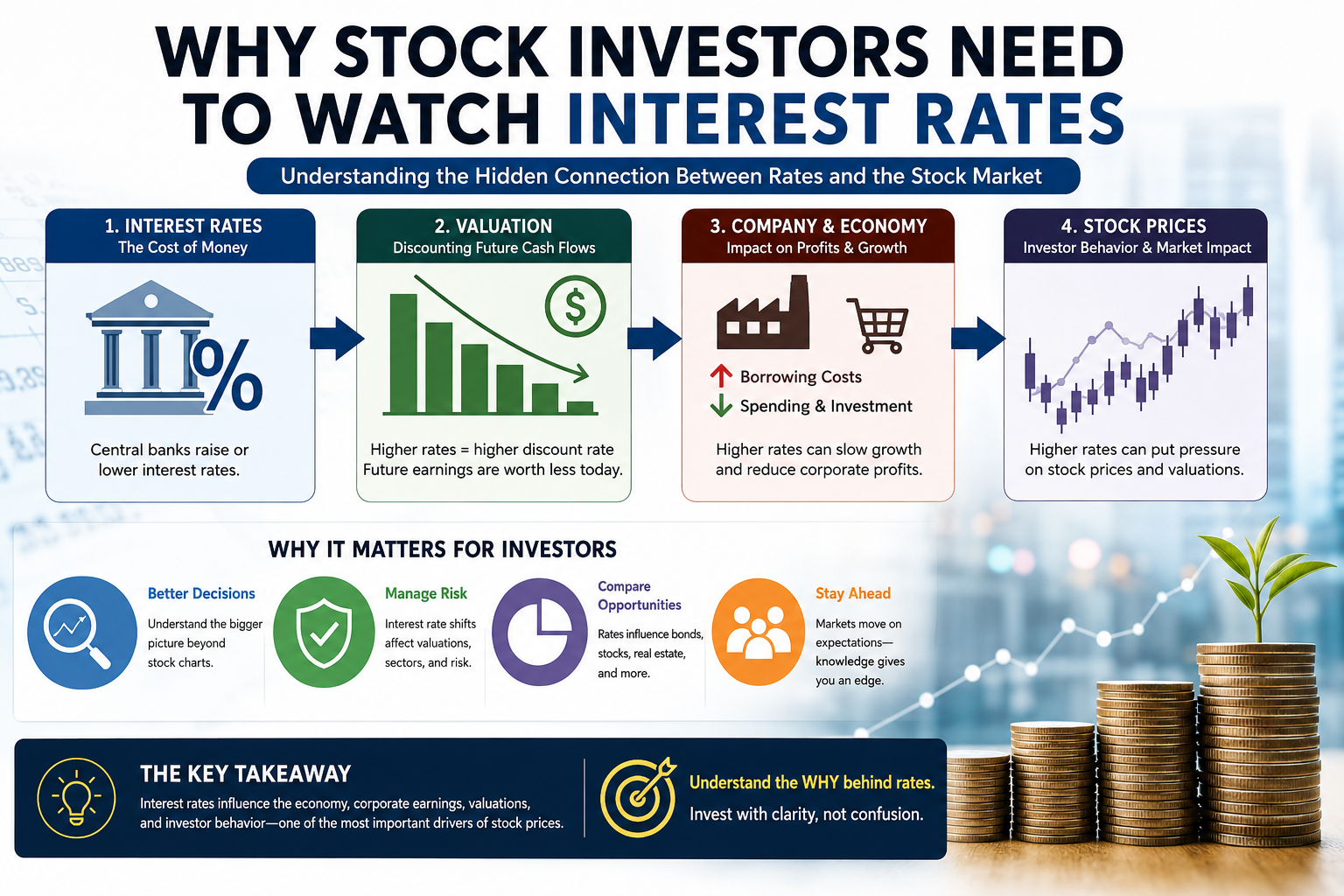
Here's what happens when interest rates rise:
- Borrowing becomes more expensive for individuals and businesses
- Companies may reduce investment in new projects
- Consumers typically spend less on discretionary items
- Bond yields become more attractive relative to stocks
- Stock valuations often come under pressure
Conversely, when interest rates fall, borrowing becomes cheaper, financial conditions improve, and investors may become more willing to take risks. This is why interest rates matter so much to the stock market.
The Valuation Effect: Why Rising Rates Hurt Future Earnings
Here's the key question that connects interest rates to stock prices: "What is a dollar earned in the future worth today?"
Imagine a company is expected to generate significant profits ten years from now. When investors determine what that company is worth, they need to convert those future profits into today's value. This process is called discounting future cash flows.
When interest rates rise, the discount rate used in this calculation typically rises as well. As a result, those future earnings become worth less in today's valuation. This puts downward pressure on stock prices, especially for companies whose profits are expected far in the future.
A Practical Example
Let's make this concrete. Imagine you're choosing between two investments:
Investment A: A relatively safe interest-bearing asset offering a 5% return.
Investment B: A risky company that might generate significant profits several years from now.
When safe interest rates are extremely low, investors are willing to take more risk to chase higher returns. But if safe interest rates rise substantially, investors start asking: "Why take additional risk when I can earn a reasonable return with much less risk?"
This psychological shift is one of the key mechanisms through which higher interest rates can reduce demand for stocks.
Why Growth Stocks Are Extra Sensitive
Not every stock reacts to interest rates in the same way. Growth companies are particularly sensitive because their valuations depend heavily on expected earnings far in the future.
Consider a technology company expected to generate rapidly increasing profits over the next decade. When interest rates are low, investors may place a relatively high value on those future profits. But if interest rates rise significantly, those distant future cash flows become much less valuable when discounted back to the present. This can cause investors to reconsider how much they're willing to pay for the stock.
Importantly, this doesn't mean every growth stock will fall when rates rise. Company earnings, competitive advantages, industry conditions, and investor expectations still matter. But rising interest rates do change the valuation environment in which those stocks are priced.
Interest Rates Affect Companies Directly
Beyond valuation effects, interest rates also impact corporate earnings directly. Imagine a company with substantial debt. If it needs to refinance that debt at a higher interest rate, its interest expenses increase. Higher interest expenses reduce:
Revenue → Operating Profit → Net Income → Earnings Per Share
This means rising interest rates can create a double pressure on certain companies:
- Valuation Effect: Future profits become less valuable when discounted at higher rates
- Earnings Effect: Higher borrowing costs directly reduce corporate profitability
This combination can create significant downward pressure on stock prices, especially for debt-heavy companies.
How Interest Rates Change Investor Behavior
Investors don't make decisions in isolation. They constantly compare different investment opportunities. Suppose government bonds are offering very low yields. An investor may decide to buy stocks because the potential stock returns look attractive by comparison. But if bond yields become substantially higher, that investor might move part of their portfolio from stocks into bonds.
This doesn't mean stocks suddenly became "bad." It simply means the relative attractiveness of different investments has changed. This concept is critical for understanding financial markets and investor behavior.
Why Strong Companies Can Have Falling Stock Prices
One of the most confusing situations for new investors is when a company reports strong earnings, growing revenue, and increasing profits, yet the stock price falls. The company might even raise its outlook. How is this possible?
Stock prices don't reflect only today's performance. They reflect expectations about the future. If investors previously expected extremely strong growth, but interest rates rise or economic conditions change, they may decide the appropriate valuation should be lower, even if the company's current performance is solid.
Therefore: Good company ≠ Guaranteed stock price increase
The stock price depends on both the company's fundamentals and what investors are willing to pay for those fundamentals at any given moment.
Valuation Is Everything
This is perhaps the most important lesson for investors. Many people ask: "Is this a good company?" But professional investors ask a different question: "How much am I paying for this company?"
A fantastic company can still be an expensive investment if its stock price already assumes extremely optimistic future growth. Conversely, a mediocre company can sometimes become attractive if its valuation is sufficiently low.
Interest rates matter because they influence the baseline used by investors to value future cash flows. This is why the same company can receive a very different valuation under different interest-rate environments.
Ripple Effects Throughout the Economy
Interest rates don't only affect Wall Street. They affect the entire economy:
Consumers: Mortgage payments, loans, and financing costs increase. Consumers reduce discretionary spending.
Businesses: Companies may delay expansion or investment projects. Growth slows.
Housing: Higher mortgage rates reduce housing affordability and demand.
Financial Markets: Investors become more cautious and reassess all asset valuations.
Therefore, the central bank's interest-rate decisions can ripple through the entire economic system, affecting everything from consumer spending to corporate earnings to stock valuations.
What Stock Investors Should Actually Monitor
You don't need to become an economist. Instead, create a simple checklist of what to watch:
1. Inflation: Is inflation accelerating or slowing? Persistent inflation makes aggressive rate cuts more difficult.
2. Central Bank Policy: Is the central bank tightening or easing financial conditions?
3. Government Bond Yields: Bond yields provide useful information about market expectations.
4. Corporate Earnings: Are companies actually growing revenue and profits?
5. Valuations: Are investors paying a reasonable price for expected future growth?
6. Economic Growth: Is the economy accelerating or slowing?
Looking at these factors together is far more useful than watching any single number in isolation.
A Simple Framework for Beginners
If you're just starting your investing journey, simplify the entire concept into four questions:
Question 1: Are interest rates rising or falling?
Question 2: Why are they moving? Is it due to inflation, economic growth, or central bank policy?
Question 3: How does this affect the companies I own? Consider their debt levels, consumer demand for their products, and investment spending.
Question 4: Is the current stock valuation already reflecting these expectations? This fourth question is particularly important because it prevents you from reacting to information that's already been priced in.
Don't Try to Predict Every Rate Move
One of the biggest mistakes investors can make is believing they need to predict exactly what the central bank will do next. You don't need to do this. Even professional investors frequently disagree about future interest rates.
Instead, build a portfolio that can survive different economic environments. For long-term investors, diversification and appropriate risk management are often more important than perfectly predicting the next rate decision.
The Markets Move on Expectations
Here's a critical insight: the stock market doesn't necessarily wait for economic data to become obvious. Investors constantly try to anticipate what will happen next. Suppose inflation begins to accelerate. Even before the central bank raises interest rates, investors may begin expecting higher future rates. Stock prices can react immediately.
Later, when the central bank actually raises rates, the market reaction may be surprisingly small because the information was already priced into the market. This is commonly described as: "The market prices in expectations."
What About Falling Interest Rates?
When interest rates decline, several things typically happen:
Lower borrowing costs: Companies may find it cheaper to finance investments and expansion.
Increased consumer spending: Lower borrowing costs improve household financial conditions.
More attractive stock valuations: Lower discount rates increase the present value of future cash flows.
Increased risk appetite: Investors search for higher returns when safer assets provide lower yields, which can be supportive for stocks.
However, there's an important caveat: falling rates are not automatically bullish. If interest rates are falling because the economy is entering a severe recession, corporate earnings could decline at the same time. In this scenario, falling rates might not help stocks if profits are collapsing.
Therefore, the most important question is not "Are rates falling?" but rather "Why are interest rates falling?"
Two Scenarios: Rate Cuts Can Mean Different Things
Scenario A: Inflation Is Under Control
Inflation is controlled. Economic growth remains relatively healthy. The central bank gradually lowers interest rates. This environment is typically supportive for stocks.
Scenario B: The Economy Is Deteriorating
Unemployment is rising. Corporate profits are weakening. Consumer spending is falling. The central bank cuts rates aggressively to support the economy. In this situation, stocks may still struggle because declining earnings can outweigh the positive effect of lower rates.
Rate cuts alone don't tell you the whole story. You must understand the context.
The Bigger Picture
Stocks do not exist in isolation. A company operates inside an economy. The economy operates inside a financial system. And the financial system is heavily influenced by the cost and availability of money.
Therefore, understanding interest rates gives you another important piece of the investment puzzle. You don't need to predict every move. You simply need to understand the direction of the environment and how it could affect the investments you own.
Final Takeaway
If you're investing in stocks, don't look only at the stock chart. Look at the bigger picture:
Interest Rates → Borrowing Costs → Economic Activity → Corporate Earnings → Valuation → Stock Prices
The relationship isn't always immediate or perfectly predictable. But understanding it can help you make more informed investment decisions and avoid reacting emotionally to short-term market movements.
The next time the stock market suddenly moves, instead of asking only: "Why did this stock go up or down?", try asking: "What happened to interest rates, inflation, economic expectations, and valuation?"
That question can lead you to a much deeper understanding of the market. Remember: investing isn't about predicting everything. It's about understanding the forces that move the market and managing your risk accordingly.
Frequently Asked Questions
Does a higher interest rate always cause stocks to fall?
No. Interest rates are just one factor affecting stock prices. Corporate earnings, economic growth, valuations, investor expectations, and market sentiment all play important roles.
Why are growth stocks sensitive to interest rates?
Growth stocks often derive a significant portion of their valuation from expected future earnings. Higher discount rates reduce the present value of those future cash flows, which can pressure valuations.
Are falling interest rates always good for stocks?
Not necessarily. Rate cuts can be positive when inflation is declining and economic growth remains healthy. But aggressive cuts caused by severe economic slowdown can coincide with falling corporate earnings, which may hurt stocks.
What should beginners focus on besides interest rates?
A useful starting point is tracking inflation, government bond yields, central bank policy, corporate earnings, economic growth, and stock valuations. These factors together paint a clearer picture than any single metric.